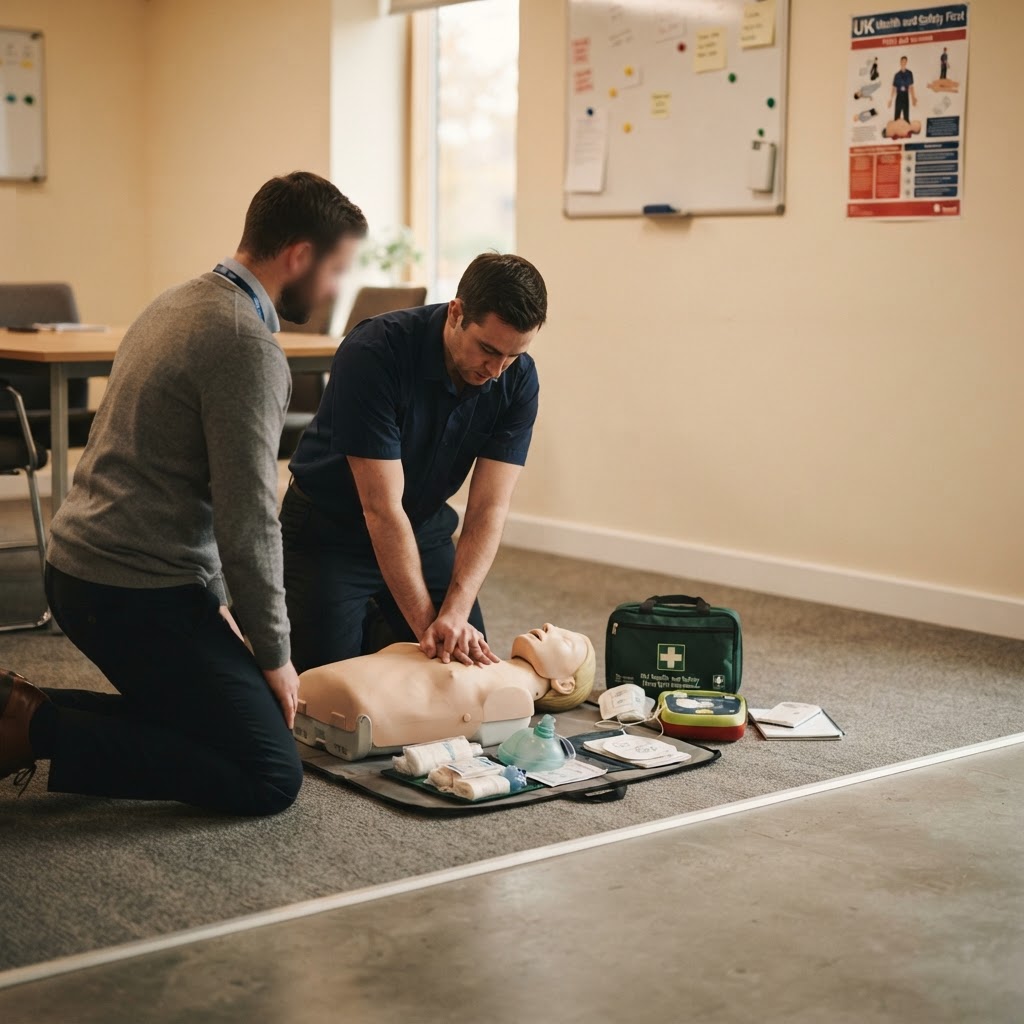
The Health and Safety (First Aid) Regulations 1981
The Health and Safety (First Aid) Regulations 1981 are the primary piece of UK legislation governing first aid provision in the workplace. They place specific legal duties on employers and self-employed persons to provide adequate first aid equipment, facilities and trained personnel.
What Do the Regulations Require?
Regulation 3 of the 1981 Regulations requires employers to provide:
- Adequate and appropriate equipment — First aid kits stocked according to HSE guidance
- Adequate facilities — A suitable first aid room where required (for larger or higher-risk workplaces)
- Trained personnel — A suitable number of qualified first aiders or an appointed person
The regulations use the term 'adequate and appropriate' — meaning first aid provision must be proportionate to the workplace's specific needs, determined through a first aid needs assessment.
The First Aid Needs Assessment
Employers must conduct a first aid needs assessment considering:
- Nature of the work and workplace hazards
- Number of employees and their distribution
- Shift patterns and out-of-hours working
- Location of the workplace relative to emergency services
- History of accidents and ill health
- Needs of travelling, remote and lone workers
- Provision for non-employees (visitors, contractors, members of the public)
Approved Code of Practice (ACOP)
The HSE's Approved Code of Practice and Guidance (L74) provides detailed guidance on complying with the regulations. While the ACOP is not law itself, it provides a benchmark for compliance — following the ACOP is considered evidence of compliance with the regulations.
First Aid Equipment Requirements
HSE guidance recommends first aid kits contain:
- Guidance leaflet on first aid
- Sterile plasters in assorted sizes
- Sterile eye pads
- Triangular bandages
- Safety pins
- Medium and large sterile dressings
- Disposable gloves
The exact contents should be determined by the first aid needs assessment. Additional items such as scissors, tweezers, burns dressings and resuscitation face shields may be needed for higher-risk workplaces.
Recording Requirements
Employers must record all first aid treatment provided in a first aid accident book or incident reporting system. Serious accidents, injuries and dangerous occurrences must also be reported under RIDDOR (Reporting of Injuries, Diseases and Dangerous Occurrences Regulations 2013).
Enforcement and Penalties
The HSE and local authorities enforce the 1981 Regulations. Non-compliance can result in:
- Improvement notices — Requiring remedial action within a specified timeframe
- Prohibition notices — Stopping work activities until remedial action is taken
- Prosecution — In the magistrates' or Crown Court
- Unlimited fines — Following prosecution
- Imprisonment — For serious breaches by responsible persons
Book First Aid Training in Yorkshire
Livius Training provides HSE-recognised first aid courses including EFAW, FAW, Paediatric First Aid and Blended Paediatric First Aid. Training is delivered at our Boroughbridge centre or on-site across Yorkshire. View first aid courses or call 01423 396780.